

Introduction
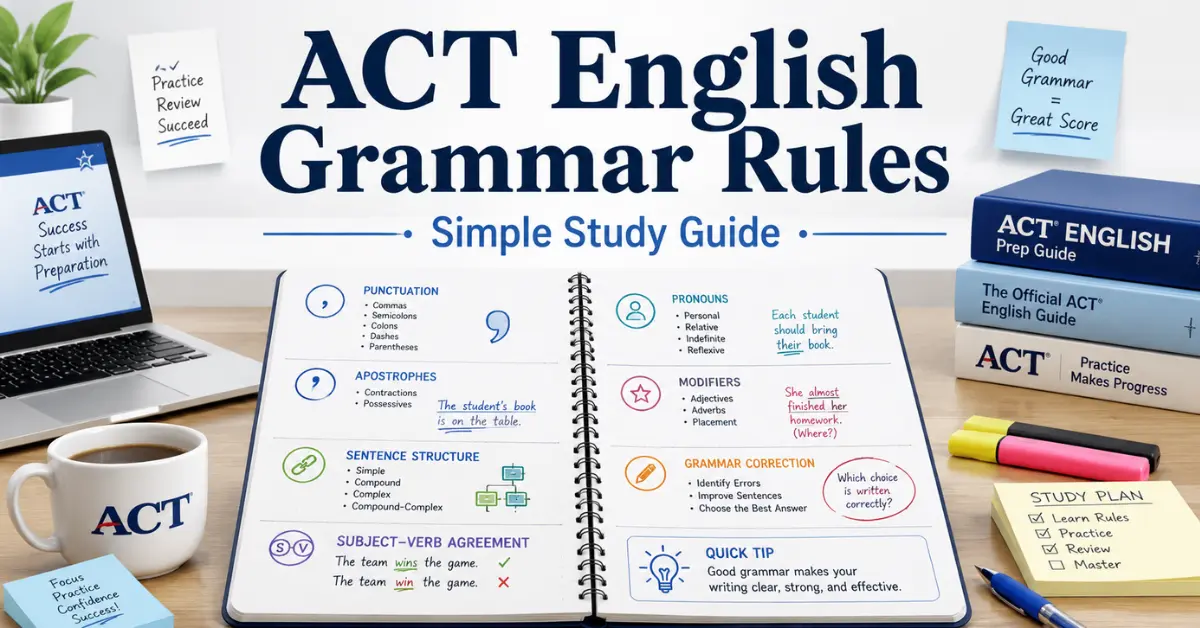
ACT English grammar rules can feel hard at first, but they become easy when you learn them step by step. The ACT English section tests how well you fix sentences, punctuation, word choice, and writing flow. You do not need to know every grammar term. You need to know how correct English works in real test questions.
This guide explains act english grammar rules in simple words. You will learn the main rules, common mistakes, and clear examples. You will also see how to choose the best answer faster.
Think about this question: does the sentence sound clear, short, and correct? If yes, you are often close to the right answer. Let’s break it down.
What Are ACT English Grammar Rules?

ACT English grammar rules are the writing rules tested in the ACT English section. These rules help you choose clear, correct, and smooth sentences. The test checks grammar, punctuation, sentence structure, style, and organization.
You will see short passages with underlined parts. Each question asks you to fix or improve one part. Sometimes the best answer says “NO CHANGE.” That means the original sentence already works.
The ACT does not ask you to define grammar terms. It asks you to use grammar in real sentences. For example:
Incorrect: She go to school every day.
Correct: She goes to school every day.
The subject “she” needs the verb “goes.” This is a subject-verb agreement rule.
Common act english grammar rules include:
- Subject-verb agreement
- Verb tense
- Pronoun use
- Commas and semicolons
- Sentence fragments
- Run-on sentences
- Word choice
- Clear meaning
Your goal is simple. Pick the answer that makes the sentence correct, clear, and short.
You May Also Like It:
URL Decoder SpellMistake – Easy Guide for Beginners
English Grammar Sentence Structure Rules Guide
Practical Writing Tips for Better Content Writing
ACT English Grammar Rules for Subject-Verb Agreement
Subject-verb agreement means the subject and verb must match. A singular subject needs a singular verb. A plural subject needs a plural verb.
Example:
Incorrect: The student write notes.
Correct: The student writes notes.
“Student” means one person, so the verb needs “writes.”
Plural example:
Incorrect: The students writes notes.
Correct: The students write notes.
The ACT often places extra words between the subject and verb to confuse you.
Example:
The box of old books is on the table.
The subject is “box,” not “books.” So the verb must be “is.”
Watch for phrases like:
- of the students
- with her friends
- along with the team
- near the windows
These phrases do not change the subject.
Quick tip: Cross out extra phrases in your mind. Then check the real subject and verb.
This is one of the most common act english grammar rules because it appears often in test passages.
ACT English Grammar Rules for Verb Tense
Verb tense shows time. It tells if something happened in the past, happens now, or will happen later. The ACT checks if verb tense stays clear and consistent.
Example:
Incorrect: Yesterday, Maya walks to the store and bought milk.
Correct: Yesterday, Maya walked to the store and bought milk.
“Yesterday” shows past time. Both verbs should show past time.
You should also watch the other verbs in the same sentence or paragraph. If the passage uses past tense, the answer should usually stay in past tense.
Example:
The scientist tested the sample and recorded the results.
Both verbs match in tense.
Do not change tense unless the sentence clearly changes time.
Example:
Last year, he played soccer. Now, he plays tennis.
This works because “last year” and “now” show different times.
ACT English grammar rules often test tense through small changes. Read the full sentence before you choose. Do not pick an answer just because it sounds fancy.
Pronoun Rules on the ACT English Test
Pronouns replace nouns. Words like he, she, it, they, them, and who are pronouns. On the ACT, pronouns must be clear and correct.
A pronoun must match the noun it replaces.
Example:
Incorrect: The dog wagged their tail.
Correct: The dog wagged its tail.
“Dog” is singular, so “its” works better than “their.”
The ACT also checks unclear pronouns.
Example:
When Jake called Ryan, he was angry.
Who was angry, Jake or Ryan? The sentence is unclear.
Better: Jake was angry when he called Ryan.
Pronouns also need the right case.
Example:
Incorrect: Her and I studied together.
Correct: She and I studied together.
Use “I” and “she” as subjects. Use “me” and “her” as objects.
Example:
Correct: The teacher helped her and me.
Here, “her and me” receive the action.
When studying act english grammar rules, always ask: What noun does this pronoun replace? If you cannot answer clearly, the sentence needs a fix.
Punctuation Rules You Must Know
Punctuation questions appear many times on ACT English. You should know commas, semicolons, colons, and apostrophes.
A comma often separates extra information.
Example:
My brother, who loves science, won the contest.
The phrase “who loves science” adds extra detail. The sentence still works without it.
Use a semicolon to join two complete sentences that relate closely.
Example:
I studied all night; I felt ready for the test.
Both sides can stand alone as complete sentences.
Use a colon after a complete sentence to introduce a list or explanation.
Example:
She packed three items: a pencil, a snack, and a calculator.
Do not use a colon after an incomplete sentence.
Incorrect: She packed: a pencil, a snack, and a calculator.
Apostrophes show ownership or contractions.
Examples:
- The girl’s book means one girl owns the book.
- The girls’ book means more than one girl owns the book.
- It’s means it is.
- Its shows ownership.
These act english grammar rules can save many points because punctuation errors follow clear patterns.
Sentence Structure and Complete Sentences
A complete sentence needs a subject and a verb. It must also express a full thought. The ACT often tests fragments and run-on sentences.
A fragment is an incomplete sentence.
Incorrect: Because the rain started early.
Correct: Because the rain started early, we stayed inside.
The first example does not finish the thought.
A run-on sentence joins two full sentences without correct punctuation.
Incorrect: I finished my homework I went outside.
Correct: I finished my homework, and I went outside.
You can fix a run-on with:
- A period
- A semicolon
- A comma plus a joining word
- A clear rewrite
Joining words include and, but, or, so, for, yet.
Example:
Correct: I wanted to sleep, but I had to study.
ACT English grammar rules often reward clean sentence structure. The best answer usually avoids long, messy wording. Choose the answer that says the idea in the clearest way.
Commas, Extra Details, and Clear Meaning
Commas can change meaning. The ACT often tests whether commas sit in the right place.
Use two commas around extra details.
Example:
The coach, who trained us daily, helped us win.
The extra phrase can be removed:
The coach helped us win.
The sentence still works.
Do not place one comma only if the extra detail needs two.
Incorrect: The coach, who trained us daily helped us win.
This feels broken because the extra detail never closes.
Some details are needed for meaning. Do not place commas around needed information.
Example:
The student who won the award gave a speech.
“Who won the award” tells us which student. It is needed, so no commas.
Ask this simple question: Can I remove this detail and keep the main meaning?
If yes, commas may be needed.
If no, commas may not be needed.
This is one of the most useful act english grammar rules for punctuation questions.
Word Choice and Clear Style
The ACT likes clear and simple writing. Many wrong answers sound wordy or awkward. The best answer often uses fewer words.
Example:
Wordy: Due to the fact that it was raining, we stayed home.
Better: Because it was raining, we stayed home.
Both mean the same thing, but the second sentence is cleaner.
Avoid repeat words.
Incorrect: The final result at the end surprised us.
Correct: The result surprised us.
“Final” and “at the end” repeat the same idea.
The ACT also tests commonly confused words.
Examples:
- affect means to change
- effect means a result
- than compares things
- then shows time
- its shows ownership
- it’s means it is
- fewer works with countable things
- less works with amounts
Example:
Correct: Fewer students joined the club this year.
You can count students, so “fewer” works.
Act english grammar rules are not only about grammar. They also test clear writing. Pick the answer that sounds natural and direct.
You May Also Like It:
Best Blog Writing Tips for Better Content
Blog Content Writing Tips for SEO and Engagement
Page Size Checker by SpellMistake SEO Guide
Organization and Transition Questions
ACT English also tests how ideas fit together. Some questions ask where a sentence should go. Others ask which transition word works best.
Transition words show the link between ideas.
Examples:
- however shows contrast
- therefore shows result
- for example introduces proof
- also adds more information
- in contrast shows difference
Example:
I wanted to go outside. However, the storm grew stronger.
“However” works because the second sentence gives a contrast.
Do not choose a transition only because it sounds smart. Check the meaning.
Example:
Incorrect: I studied hard. However, I passed the test.
Better: I studied hard. Therefore, I passed the test.
The second sentence shows a result, not a contrast.
For sentence placement questions, look at the topic before and after the sentence. The sentence should connect smoothly.
Ask yourself:
- What is this paragraph mainly about?
- Does this sentence support that idea?
- Where does it fit best?
These act english grammar rules help you answer more than basic grammar questions.
Common ACT English Grammar Mistakes to Avoid

Many students lose points because they rush. The ACT gives limited time, so you need smart habits.
Common mistakes include:
- Picking the shortest answer every time
The shortest answer often works, but not always. It must also be correct. - Ignoring the full sentence
Some errors appear before or after the underlined part. Always read around it. - Choosing what “sounds right” only
Your ear helps, but rules matter too. - Missing punctuation clues
Commas, semicolons, and periods often decide the answer. - Forgetting the meaning
A sentence can sound correct but still say the wrong thing.
Example:
The hikers brought water because they were thirsty.
This makes sense.
The hikers brought water although they were thirsty.
This sounds odd because “although” shows contrast.
To improve, practice with real ACT-style questions. After each mistake, write down the rule. Soon you will see patterns.
This is the best way to learn act english grammar rules without feeling lost.
How to Study ACT English Grammar Rules
You do not need to study all grammar at once. Start with the rules that appear most often. Then practice them in short daily sessions.
Use this simple study plan:
Day 1: Subject-verb agreement
Day 2: Verb tense
Day 3: Pronouns
Day 4: Commas
Day 5: Semicolons and colons
Day 6: Sentence structure
Day 7: Mixed practice
Read every wrong answer carefully. Ask why it is wrong. This step matters more than doing many questions without review.
Make a small error log. Write:
- The question type
- Your wrong answer
- The correct rule
- A simple example
For example:
Rule: A semicolon joins two complete sentences.
Example: I practiced daily; my score improved.
Also, time yourself. ACT English has many questions, so speed matters. But accuracy comes first. Once you know the rules, you will answer faster.
Keep practice short and steady. Fifteen focused minutes each day can help more than one long study session.
FAQs on ACT English Grammar Rules
- What is the ACT English section?
The ACT English section tests grammar, punctuation, sentence structure, and writing clarity. - How many questions are in ACT English?
There are 75 questions in the ACT English section. - How much time do you get for ACT English?
You get 45 minutes to complete the section. - What grammar rule appears most on the ACT?
Comma rules and sentence structure questions appear very often. - Does the ACT test spelling?
No. The ACT mainly tests grammar and writing skills. - What is a run-on sentence?
A run-on sentence joins two complete ideas without proper punctuation. - What is a sentence fragment?
A fragment is an incomplete sentence that does not express a full idea. - Can reading help improve ACT English scores?
Yes. Reading good writing helps you notice grammar patterns and sentence flow. - Should I guess if I do not know the answer?
Yes. The ACT does not remove points for wrong answers. - How often should I practice ACT English grammar rules?
Practice a little every day for better improvement and stronger memory.
Conclusion
ACT English grammar rules become much easier when you study the main patterns. Focus on subject-verb agreement, verb tense, pronouns, punctuation, sentence structure, word choice, and transitions. These areas appear often on the ACT English test.
Do not try to memorize hard grammar terms. Learn how each rule works in real sentences. Read the full sentence, check the meaning, and choose the clearest answer. Also, review your mistakes after every practice set. That helps you fix weak areas fast.
The best part is that grammar improves with practice. Start small, stay consistent, and use simple examples. If you follow these act english grammar rules, you can feel more confident and raise your ACT English score.
You May Also Like It:
Backlink Maker by Alaikas: Complete SEO Guide
Suspicious Domain Checker by Alaikas Guide
