

Introduction
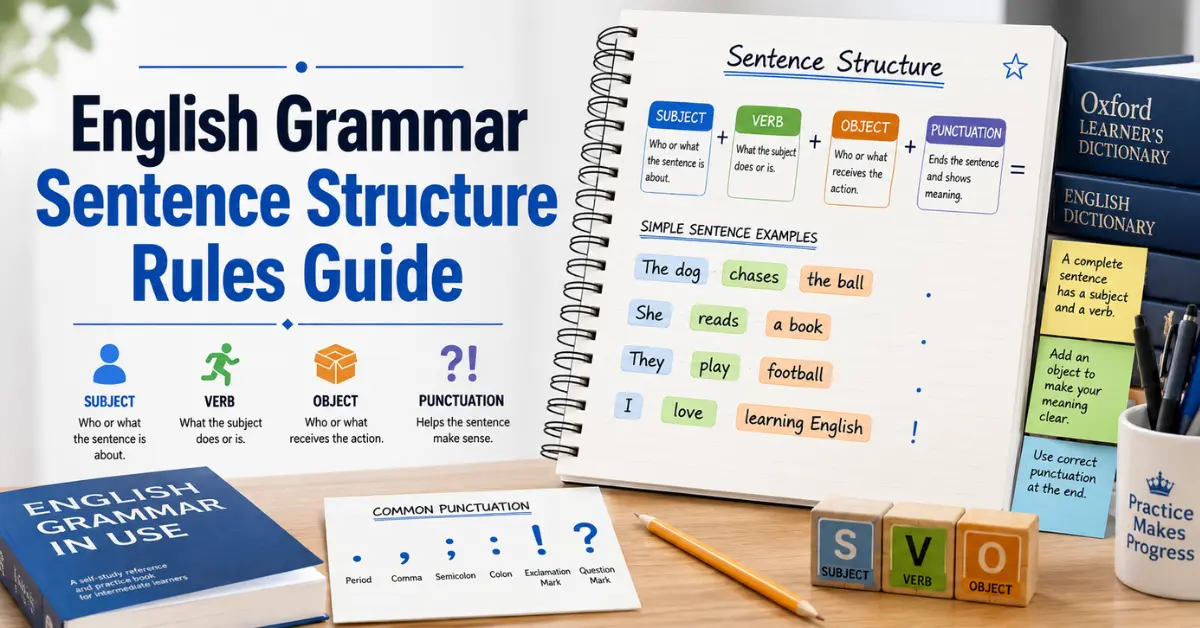
English grammar sentence structure rules help you write clear and correct sentences. These rules show you how to place words in the right order. They also help your reader understand your message without confusion.
Good sentence structure matters in school, work, blogging, emails, and daily writing. A weak sentence can confuse readers. A strong sentence can explain your idea fast.
In this guide, you will learn English grammar sentence structure rules in a simple way. You will see examples, common mistakes, and easy fixes. You do not need advanced grammar knowledge. You only need to learn the basic pattern and practice it.
What Are English Grammar Sentence Structure Rules?
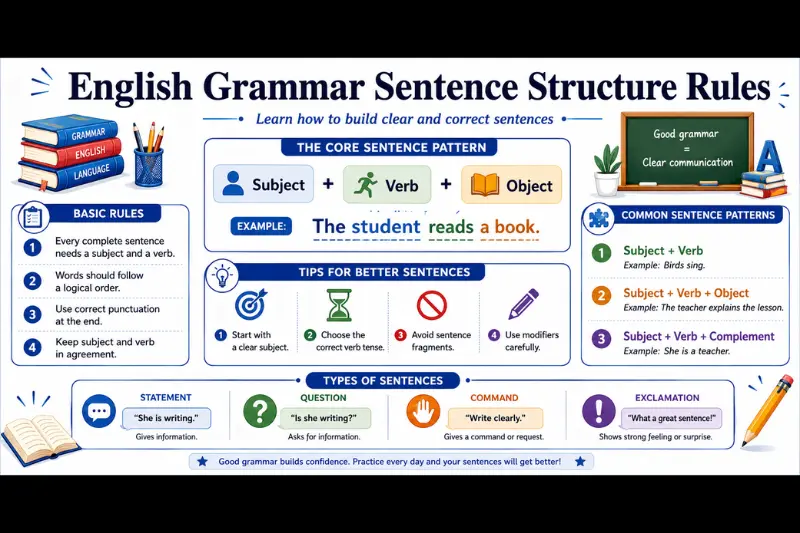
English grammar sentence structure rules explain how words work together in a sentence. A sentence needs a clear idea. Most sentences need a subject and a verb.
The subject tells who or what the sentence talks about. The verb tells what the subject does.
Example:
Sara reads a book.
- Sara = subject
- reads = verb
- a book = object
The object receives the action. In this example, Sara does the action, and the book receives it.
English grammar sentence structure rules help you avoid mixed or broken sentences. They also help you write in a natural order.
Basic English sentence order often follows this pattern:
Subject + Verb + Object
Examples:
- I drink water.
- He writes emails.
- They play football.
- We study grammar.
Ask yourself: Who does the action? What action happens? What receives the action? This simple check can improve your sentence fast.
You May Also Like It:
ACT English Grammar Rules – Simple Study Guide
URL Decoder SpellMistake – Easy Guide for Beginners
Practical Writing Tips for Better Content Writing
Why English Grammar Sentence Structure Rules Matter
English grammar sentence structure rules matter because they make your writing easy to read. Readers should not guess your meaning. Your sentence should guide them clearly.
Look at this weak sentence:
Running fast the boy to school went.
This sentence sounds confusing. Now read the better version:
The boy ran fast to school.
The second sentence follows a clear order. It tells who did the action, what he did, and where he went.
Good sentence structure helps you:
- Write clear blog posts
- Send better emails
- Improve school work
- Speak with more confidence
- Avoid grammar mistakes
Clear sentences also help search engines understand your content. If you write online, this matters. A clean sentence gives value to readers and supports SEO.
English grammar sentence structure rules do not make writing hard. They make writing simple. Once you learn the patterns, you can build better sentences with less stress.
The Basic Sentence Pattern in English Grammar Sentence Structure Rules
The most common sentence pattern in English is:
Subject + Verb + Object
This pattern works in many daily sentences.
Examples:
- The teacher explains the lesson.
- My brother fixed the chair.
- I opened the window.
- She cooked dinner.
Each sentence gives a complete thought. It tells who does something and what happens.
You can also add more details. These details tell where, when, why, or how.
Example:
She cooked dinner at home last night.
Here is the structure:
- She = subject
- cooked = verb
- dinner = object
- at home = place
- last night = time
A simple sentence can grow, but it should still stay clear.
Try this pattern:
Who + action + what + where + when
Example:
Ali finished his homework in his room after dinner.
This sentence gives a full idea. It does not confuse the reader.
English grammar sentence structure rules help you place each part in the right spot.
Types of Sentences You Should Know
English has different sentence types. Each type has a different job. When you know these types, you can write with more control.
1. Simple Sentence
A simple sentence has one complete idea.
Example:
I like tea.
2. Compound Sentence
A compound sentence joins two complete ideas. You can use words like and, but, or, so.
Example:
I like tea, but my brother likes coffee.
3. Complex Sentence
A complex sentence has one main idea and one extra idea.
Example:
I stayed home because it rained.
The main idea is I stayed home. The extra idea is because it rained.
4. Compound-Complex Sentence
This sentence joins two complete ideas and one extra idea.
Example:
I stayed home because it rained, and I watched a movie.
English grammar sentence structure rules help you choose the right sentence type. Use simple sentences for clear points. Use longer sentences when you need more detail.
Subject, Verb, and Object: The Main Parts
A strong sentence needs strong parts. The three main parts include subject, verb, and object.
The subject tells who or what performs the action.
Examples:
- The dog barked.
- My sister smiled.
- The phone rang.
The verb shows the action or state.
Examples:
- run
- eat
- write
- think
- is
- are
The object receives the action.
Example:
The girl kicked the ball.
- The girl = subject
- kicked = verb
- the ball = object
Some sentences do not need an object.
Example:
The baby slept.
This sentence still makes sense because the idea feels complete.
English grammar sentence structure rules help you check if your sentence has the parts it needs. When a sentence feels wrong, find the subject and verb first. This simple step often shows the problem.
Word Order Rules in English Sentences
Word order means the way you place words in a sentence. English uses a fixed order in many cases.
The normal order is:
Subject + Verb + Object + Place + Time
Example:
I met my friend at the park yesterday.
This sounds natural.
Now look at this version:
Yesterday at the park my friend I met.
This sounds wrong in normal English.
Here are more examples:
Correct:
- She reads books every night.
- We visited Lahore last week.
- He bought a new phone yesterday.
Incorrect:
- Reads she books every night.
- Lahore we visited last week.
- A new phone he bought yesterday.
English grammar sentence structure rules help you follow natural word order. You can move time words for style, but keep the main parts clear.
Example:
Yesterday, I bought a new phone.
This works because the subject and verb still follow a clear order.
You May Also Like It:
Best Blog Writing Tips for Better Content
Blog Content Writing Tips for SEO and Engagement
Page Size Checker by SpellMistake SEO Guide
Common Sentence Structure Mistakes
Many writers make the same sentence structure mistakes. The good news: you can fix them with simple checks.
1. Sentence Fragment
A fragment does not give a full idea.
Wrong:
Because I was tired.
Better:
I slept early because I was tired.
2. Run-On Sentence
A run-on sentence joins ideas without correct punctuation.
Wrong:
I was hungry I made a sandwich.
Better:
I was hungry, so I made a sandwich.
3. Missing Subject
Wrong:
Went to the market.
Better:
I went to the market.
4. Wrong Word Order
Wrong:
She to school goes daily.
Better:
She goes to school daily.
English grammar sentence structure rules help you catch these errors. Read your sentence aloud. If it sounds confusing, check the subject, verb, and word order.
How to Build Better Sentences Step by Step

You can build strong sentences by following a simple process.
Step 1: Start With the Main Idea
Ask: What do I want to say?
Example idea:
My friend helped me.
Step 2: Add Details
Add where, when, why, or how.
Example:
My friend helped me with my project last night.
Step 3: Check the Word Order
Make sure the sentence follows a clear order.
Subject: My friend
Verb: helped
Object: me
Detail: with my project last night
Step 4: Remove Extra Words
Weak:
My friend really actually helped me with my project last night.
Better:
My friend helped me with my project last night.
Step 5: Read It Aloud
Your ear can catch mistakes your eyes miss.
English grammar sentence structure rules work best when you practice them daily. Write one sentence. Check it. Improve it. This habit builds skill over time.
Examples of English Grammar Sentence Structure Rules in Real Life
Let’s look at real-life writing examples. These examples show how small changes can improve clarity.
Email example:
Weak:
Meeting tomorrow we will discuss project.
Better:
We will discuss the project in tomorrow’s meeting.
School example:
Weak:
Because the exam was hard.
Better:
Many students felt nervous because the exam was hard.
Blog example:
Weak:
Good grammar helps readers and writing better.
Better:
Good grammar helps readers understand your writing better.
Work message example:
Weak:
Report I sent yesterday to manager.
Better:
I sent the report to the manager yesterday.
Social media example:
Weak:
This tip useful for beginners is.
Better:
This tip is useful for beginners.
English grammar sentence structure rules make each message cleaner. You do not need long sentences to sound smart. You need clear sentences that share one idea at a time.
Simple Tips to Improve Sentence Structure
You can improve sentence structure with daily practice. Start with small changes.
Use these tips:
- Keep one main idea in each sentence.
- Use short sentences for important points.
- Place the subject near the verb.
- Avoid too many extra words.
- Mix short and medium sentences.
- Read your writing aloud.
- Fix unclear word order.
- Check every sentence for a complete idea.
Here is a simple editing method:
- Find the subject.
- Find the verb.
- Check the object.
- Remove extra words.
- Read the sentence again.
Example:
Weak:
The article that I wrote yesterday for my blog about grammar tips and sentence rules was very useful for many new writers.
Better:
I wrote a useful grammar article for new writers yesterday.
English grammar sentence structure rules help you write with confidence. Your goal should stay simple: make every sentence easy to understand.
FAQs English Grammar Sentence Structure Rules
1. What is sentence structure in English grammar?
Sentence structure is the way words are arranged to form a correct sentence.
2. What are the basic parts of a sentence?
The main parts are subject, verb, and object.
3. What is the most common sentence pattern?
The most common pattern is subject + verb + object.
4. Why are sentence structure rules important?
They make writing clear and easy to understand.
5. What is a simple sentence?
A simple sentence has one complete idea.
6. What is a compound sentence?
A compound sentence joins two complete ideas with words like and or but.
7. What is a sentence fragment?
A fragment is an incomplete sentence that lacks a full idea.
8. How can I improve my sentence structure?
Practice writing daily and check word order carefully.
9. What is wrong word order in English?
Wrong word order places words in an unnatural way that confuses readers.
10. Can short sentences improve writing?
Yes. Short sentences make content clearer and easier to read.
Conclusion
English grammar sentence structure rules help you write clear, correct, and useful sentences. You learned how subjects, verbs, objects, and word order work together. You also saw sentence types, common mistakes, and real-life examples.
Good writing does not need hard words. It needs clear ideas in the right order. Start with the basic pattern: subject + verb + object. Then add details like time, place, and reason.
Use English grammar sentence structure rules each time you write a blog post, email, school answer, or message. With practice, your sentences will sound smoother and stronger. Keep checking your work. Read it aloud. Fix unclear parts. Small daily practice can make your writing much better.
You May Also Like It:
Backlink Maker by Alaikas: Complete SEO Guide
Suspicious Domain Checker by Alaikas Guide
